Essays

  • Life on the Slow Train

    I like to see it lap the Miles –

    And lick the Valleys up – 

    And stop to feed itself at Tanks – 

    And then – prodigious step

    Around a Pile of Mountains – 

    And supercilious peer

    In Shanties – by the sides of Roads – 

    And then a Quarry pare

    To fit its sides

    And crawl between

    Complaining all the while

    In horrid – hooting stanza – 

    Then chase itself down Hill – 

    And neigh like Boanerges – 

    Then – prompter than a Star

    Stop – docile and omnipotent

    At it’s own stable door – 

    I like to see it lap the Miles – Emily Dickinson, Poetry Foundation

    There is something about a backpack and a book that makes the world feel lighter.

    I was in Sydney for a family holiday — not the restful kind, but the good kind, full of people and movement and the particular pleasure of being somewhere that is not home. Over two days, I took public transport from Rose Bay to St Ives, accompanying my daughter to a sleepover with a friend whose parents I hadn’t yet met. She is old enough now to cross a city alone, but this was an unfamiliar city and an unknown home, and so I went with her — there and back on the first day, and there and back again the next. Thirty kilometres each way. Two trains and a bus. An hour and a half in each direction. I took books and a magazine and tried to stay away from my screens.

    The journey was, on the surface, clunky and inconvenient. It was long. It was slow. And yet somewhere between the first train and the second, something in me loosened. The absence of urgency had something to do with it — we had no hard deadline on the way there, and even on the return, with the airport somewhere ahead of us, the pressure was still distant, still soft at the edges. 

    But it was not only that. Everything on this route was unfamiliar — the stations, the rhythm of the lines, the way the city rearranged itself as we moved through it. The track was reliable and seamless, so there was nothing to worry about, but there was everything to look at. 

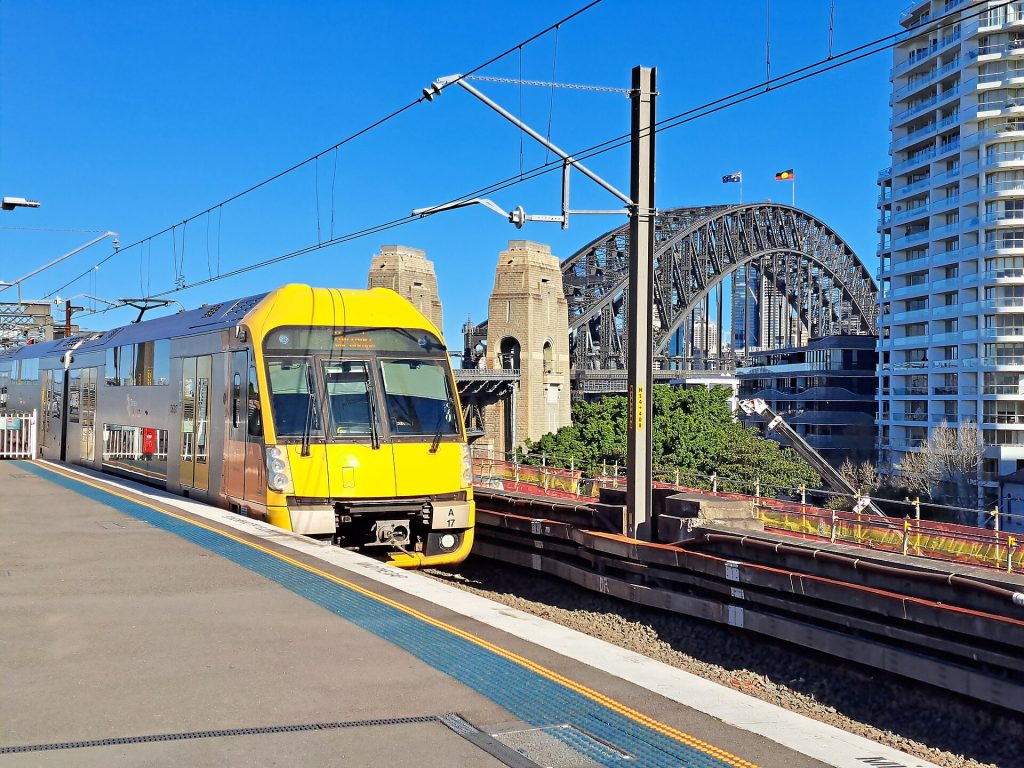
    As we approached the harbour, the view from the window clamoured for attention. The sky was a deep, certain blue, stretched clear and wide over the city. We passed the Kirribilli Markets, stalls and wanderers and the special hum of a weekend morning. For a moment, I wanted to climb down from my seat and join them — drawn by that old human pull toward beautiful things and other people’s Sundays. The train stopped at the station, but I stayed in my seat.
    Slow Train - on Contemplative Living

    The book in my hands was Think by Svend Brinkmann — slim, dense, rich with ideas that required my focus. It was a book that asked me to slow down, and the train, as it turned out, was asking the same thing. Neither the journey nor the reading had any urgency. And nor did I. Instead, I did not rush through lines or scan ahead. I read slowly, looked up frequently, let my eyes rest on the passing city, then returned to the page. It did not feel like distraction. It felt like being.

    Brinkmann, on those pages, was writing about the distinction Hannah Arendt draws in her (unfinished) book The Life of the Mind — drawing from Kant — between thinking and knowing. Knowledge, Arendt argues, is the accumulation of information that helps us function and survive. Thinking is something else entirely. It has no instrumental goal. It is done for its own sake, because the only thing it seeks is meaning. And through thinking, she writes, we can rise — even briefly — above the practical demands of living, and simply watch and reflect.

    Brinkmann continues, explaining:

    Arendt notes the etymological connection between the word theory (derived from theos), and the divine. To theorise and think philosophically is temporarily to adopt a divine view of the world. This is also supposedly the origin of the word theatre. When we are able to think and philosophise, we view the world as if we are gods in a theatre. This is true happiness. Achieving this requires a contemplative way of life that frees us from work, production and consumption – not as a permanent state of being, but from time to time. (Think, p. 78–79*)

    I set the book down and looked out the window. The words were still settling in me, finding their places. And as the city moved past, I understood that the passage was not describing something aspirational. It was describing exactly what was happening. I had not engineered this. I had simply allowed it to happen.

    There is a strange irony in the fact that Julia Cameron, whose Artist’s Way I had been reading in the weeks before, would have had something to say about my moment of self-awareness. Far from sharing my sense of serendipity at the meeting of word and experience, she may well have thought I had arrived there despite myself. Her objection would have been not to the phone I had put away, but to the book in my hands. Written in the 1990s, her message to commuters was to look up and let the mind wander freely, unmediated even by words. The call to look up is the same call in every era, only in a different guise. But what she was really warning against, I think, was the same thing I had spent much of my early life doing: using engagement as a shield against the discomfort of being alone with yourself.

    I was a constant reader in my twenties — but not simply because of my love of reading alone. The quiet of my own mind was uncomfortable. If I was not in company, I was always in a book. Somewhere beneath all that engagement was an avoidance: of silence, of stillness, of whatever I might find if I sat alone with myself and had nothing to look at but my own life. I realise now that this young woman denied herself a great gift. To be alone with your own thoughts — really alone, without distraction as a buffer — is not a deprivation. It is, I have come to understand, one of the quiet privileges of being alive. The interior world, when you finally agree to inhabit it, turns out to be worth the visit.

    On the train to St Ives, I was not afraid of the quiet. I moved between the book and the window. The reading and the looking were the same activity, in a way — both a form of attention, both a refusal of hurry. The journey permitted me to be slow, and slowness gave me access to something I do not often reach on an ordinary day.

    Somewhere on that return journey, I wondered whether this experience could be reproduced deliberately. Whether I could simply decide, on an ordinary Tuesday, to take a long way somewhere. Not because it was necessary, but because the slowness itself was the point. A train. A book. A window. No hard deadline. No phone.

    The shackles are real, of course. Life is a grind. There are responsibilities and appointments and the ordinary gravity of things that must be done. I do not want to pretend otherwise. But I have been asking myself, since that journey, how difficult it would be to loosen those bonds from time to time. To take the slow train. To sit in a park. To order a coffee and not open a screen. To let the mind rise, as Arendt says it can, above the instrumental, and simply watch and reflect. To be, even briefly, a god in a theatre.

    * Svend Brinkmann, ThinkPolity Press, 2024

  • Lift High Your Eyes and See

    Lift high your eyes and see:

    Who created these?

    The One who sends out their host by count,

    Who calls them each by name:

    Given such great might and vast power,

    Not one fails to appear.

    Isaiah 40:26, Revised JPS Translation, 2023, from sefaria.org

    When I was 22 years old and on the verge of one of my greatest life adventures — moving with David, my now-husband, to London — friends of the family were staying with my mother. My ‘Uncle’ Garl offered me a piece of advice that I carried with me in my first weeks of the magical, terrifying experience of relocating to a new country so far from my own. He said this: When you walk the streets of London, be sure to look up, because that is where you will see the beauty of the city. If you only look down, you will miss it.

    I held his advice close in those initial weeks, and it ensured that I saw more than would have been likely had I focused my attention on the footpaths and my fellow pedestrians. Then, as I moved from tourist to resident, it was only fleetingly that Garl’s advice returned to me, and only then when my mind and mood were sufficiently calm to allow this possibility to enter the daily grind of life in a big city.

    The tourists are easy to spot, for they are the ones who are looking up. They are the ones seeing a location with new eyes — eyes of curiosity and appreciation. They are the ones free to stop and pause and allow their setting to be more than a backdrop — to be, in fact, a character in the drama of their day. Context and setting are central to the story of our lives, but so often they are relegated to a minor role.

    For the past three or four months, I have developed a morning ritual that has marked the slow beginning of my day. The ritual emerged in response to burnout symptoms that returned with more vengeance than I had expected. After a year of assuming that rest and self-awareness would ensure an easy path to recovery, I realised things had to change on a daily basis — and indeed, writing this now, I see with fresh eyes the inadequacies of that prescribed antidote.

    For those who are interested, my morning rituals are listed below, and they have been a genuinely beneficial practice:

    • Morning pages (journalling) — three pages of writing by hand in an A5 notepad
    • Morning prayer
    • Selecting a quote of the day for our daughter
    • The Five Tibetan Rites (yoga)
    • 15 minutes of meditation

    Happily, these months have coincided with summer, so I take my morning yoga and meditation out to our backyard, a wilderness of four large trees, a tangled lawn, overgrown groundcover, and a beloved treasure of dense clivias.

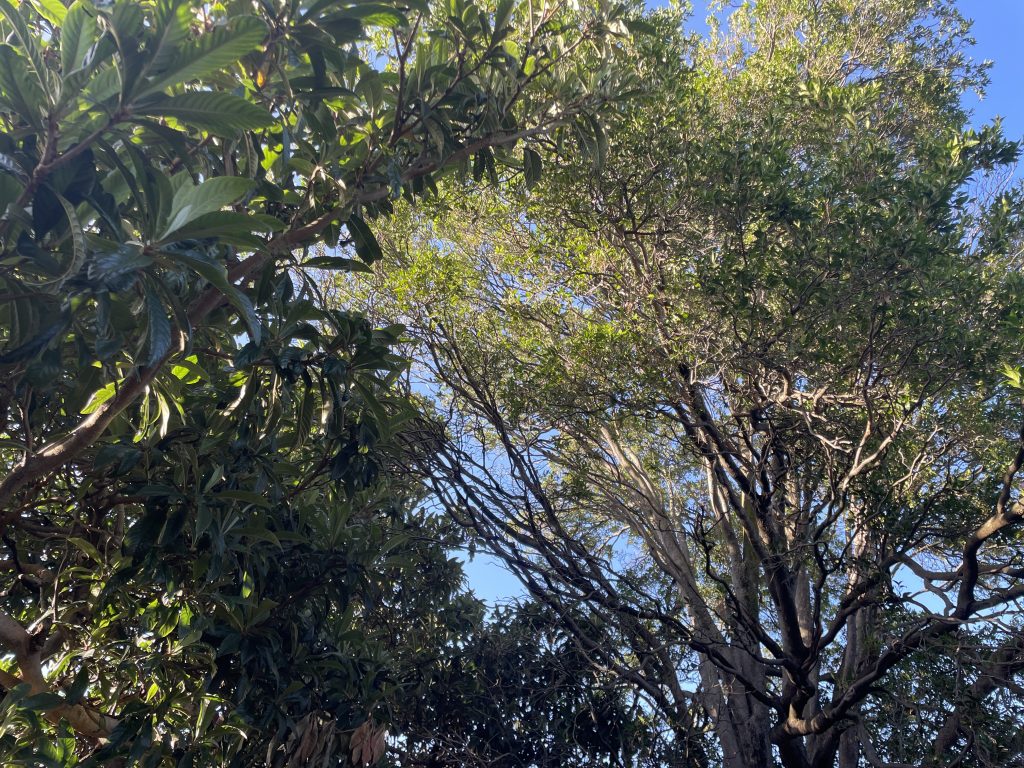
    Lying on the lawn, on a linen tablecloth that once had been white, in between my yoga and my meditation, I settle myself beneath the tree canopies and gaze towards the heavens. Each time, I am transported somewhere better. I have been reminded of the benefits of looking up.

    I stop to look up; I feel my soul breathe anew; and I question how it is that the daily downward gaze that the responsibilities and distractions of modern life bring has stolen my thirst to drink in the joy that comes from lying under a tree and looking up towards the sky.

    Those leaves, with their various greens, the way the sunlight lands on each one to produce so many shades of the same colour — they comfort and dazzle me. Those long, branching arms that stretch forth, dull in colour and rich in texture, their unpredictable turns and surfaces, their many fingers of connected twigs that reach out in every direction, ending in shiny, precious green adornments that so generously emit oxygen for us to breathe. And beyond, through the gaps in the canopy, hovers high the glorious expanse that is the sky.

    This morning’s vast blue canvas heralds a warm early autumn day. At other times, it is a patchwork of clouds and blue, or a lower-hanging blanket of whites and greys. But today, a clear azure sings above our small backyard.

    As I lie there, birdsong reaches my ears. Their melodies, intermittent and irregular, dance around the distant sound of passing cars, the voices of neighbours, and the hum of our washing machine floating to me from the laundry.

    Every morning, as I take these moments — only a few short minutes in a day that calls to me with all the things I should or could be doing — I am mesmerised by the simple splendour of it all, and wonder why I do not rush out to do this every day, throughout the day, because it is so lovely.

    Last week, I went out to add a bag of rubbish to our wheelie bin, left on the street kerb in readiness for collection the following morning. By chance, I happened to look up. The night sky was clear, the stars bright, and the air so warm and dry that it felt a crime to return inside. Rarely is the Melbourne night as perfect as that one. I took a picnic blanket from the boot of the car, laid it out on our front lawn, and stretched out below the firmaments.

    I lay there in the still of our quiet residential street and looked up at the light show hovering above — my phone inside, my family inside — and drank in that remarkable moment of connection: just me and the heavens. Over time, I made out the Milky Way and marvelled at it, not knowing when, if ever, I had seen it from our yard. Realising its rarity was unsettling, a reminder of the urban disconnection I did not — do not — want to acknowledge. So, instead, I let that go, and felt the stillness of the night air, caught the furtive scuttle of a rodent, the distant roar of someone speeding streets away, followed the movements of my body as I breathed in and out.

    For half an hour, at least, I revelled in the night version of my morning heavenward gazing. So simple and yet so primal and moving that it felt worthy of recording here today.

    How do I remember to be like a tourist? How do I remind myself to stop and feel what it is to be human in this extraordinary world, set within an infinite universe? Will I stop to take stock of this grand and glorious reality of which we are such a small and fleeting part?

    And so, I remind myself: Look up, look up, look up.

  • Crash: Letdown Effect Meets Burnout

    In late October, after an extended period of high levels of stress, the issue causing the stress was suddenly and somewhat unexpectedly resolved. Within days of this welcome change of fortune, I was struck down with a severe upper respiratory infection and crushing fatigue – a typical “letdown effect” response. But as the acute symptoms of the virus subsided, something else became apparent: this wasn’t just about the letdown effect.

    Weeks after my initial illness, I was still far from recovered. I was weak, with constant headaches and fatigue, as well as intense carbohydrate cravings. My concentration shot, my motivation and overall mojo had vanished, and simple work-related tasks left me feeling drained.

    Diagnosing the Problem

    My ever-wise mother helped me understand that there was more going on than I had first thought. Through online research and some really useful brainstorming sessions with AI (apparently, I’m not the only one doing this!), I began to realise that I wasn’t just experiencing a post-stress or post-viral crash, but the combined effects of both the letdown effect and burnout. My doctor confirmed this diagnosis.

    I could not find much discussion on the intersection of the letdown effect and burnout in medical literature. However, the more I read of each condition, the more the connection became clear. Long periods of stress can lead to burnout. If those long periods of stress are alleviated relatively quickly they can cause the letdown effect. While the letdown effect is typically acute – a sudden illness or fatigue when stress resolves – burnout is a slower, deeper depletion that can take months to develop and recover from. When they coincide, the recovery process becomes more complex.

    Having arrived at a diagnosis didn’t automatically mean that I understood its implications. After weeks of feeling less than myself, I was impatient for a return to normal. I felt self-conscious about my constant need to rest. I felt lazy.

    What Not to Do

    When some of my energy returned, I considered myself recovered and set out to build up my fitness and address the weight gain from being sedentary. However, a week of increased exercise and calorie reduction resulted in a swift relapse. I felt unwell and exhausted and had to accept that recovery was going to take longer than I’d hoped. Recovery became my priority, and I had to surrender to its timeline.

    Now, instead of fighting these symptoms, I’m learning to work with them. I am:

    • Respecting the mid-day energy dip with rest periods
    • Trying not to give in to carbohydrate cravings but not beating myself up if I do
    • Slowing my exercise pace rather than seeking to increase it
    • Only doing work that is necessary or time-sensitive
    • Prioritising tasks for my best energy hours – usually in the morning – or staggering them throughout the day.

    Recovery from burnout isn’t linear. Like all medium-term conditions, some days bring more energy and clarity, while others should be more about rest. The key seems to be looking for gradual trends: more stable energy through the day, reduced cravings, natural interest in activity returning, and improved stress tolerance for daily challenges.

    I have now internalised that taking life quietly isn’t being lazy – it’s strategic. When I accept my need for rest instead of pushing myself, I am rewarded with days in which I feel a little stronger.

    Slowly Rebuilding

    My path to recovery includes:

    • Resting during the day. Not necessarily sleeping—though some days I needed to—but sitting or lying down for extended periods. I watched television, listened to podcasts or audiobooks, and when my mind allowed, read physical books and magazines instead of electronic media.
    • Taking slower, shorter walks, despite my preference for brisk, heart-rate lifting sessions.
    • Stop stressing about weight gain and carb cravings. The time will come when I can address that issue.
    • Going into nature more. Even brief moments outdoors can be transformative. The air in the back garden, the green canopy of parks, the smell of the sea – these aren’t just pleasant sensations, they’re medicine for a depleted system.
    • Avoiding alcohol entirely, as even one or two drinks can impact a recuperating system.

    I am fortunate that I have been able to slow down and rest, primarily due to the arrival of the summer holiday season. For the most part, I have been doing little beyond the essential (even this blog piece has taken three weeks to write).

    What I Have Learned

    No lifestyle change could have helped me avoid this health condition. It arose from the realities of building a new business and endeavours like this often come with stress. It is regrettable to be unwell, but I don’t regret our decision to build a new business. These past couple of years have been incredibly challenging but they have provided me with huge learning curves – and I am wiser as a result. And, hopefully, the business will continue to grow and prosper as we emerge from these early years of trial, error … and achievement.

    My goal now isn’t to try to bounce back immediately. Instead, I want to rebuild my reserves sustainably, to be smart and patient and allow myself the time to recuperate properly. And perhaps I will learn lessons from these slow days of restoration that will help me prevent future health crashes.

    Lessons on the Letdown Effect

    In recognition of the inevitability that life brings moments of great stress and struggle, I hope to remember some of the sage advice I have learned from others about what to do to avoid the letdown effect. My two big takeaways are:

    • Transition out of stress gradually. Avoid seeking immediate relief; instead, unwind slowly. I learned this the hard way when I tried to force relaxation through alcohol – a serious mistake that likely triggered my symptoms.
    • Avoid alcohol entirely during periods of stress resolution. Two days after my ill-advised “unwind” drinking session, my symptoms began, evolving into a significant upper respiratory infection that left me sick for a fortnight.

    Lessons Regarding Burnout

    The medical advice for preventing burnout is straightforward:

    • Exercise
    • Eat a balanced diet
    • Avoid alcohol, cigarettes, and drugs
    • Sleep well
    • Maintain strong and supportive social connections.

    I would have thought this is what we should be doing at all times, but it is easier to lose sight of this when we are under pressure so it is good to be reminded.

    I’m not sure there is much that people under constant and high-level stress can do to avoid burnout other than to remove the stress from their lives before it affects them too significantly. Speaking to my doctor, I got the impression that burnout is not only common but is becoming more pervasive as the demands of our information-saturated, never-turning-off lives increase. I was fortunate: my letdown effect illness revealed my burnout before it was particularly advanced – and that letdown condition arose because my stress was alleviated. Had this not been the case, I might have continued until I was completely unable to function, as happens to some. They go on until even getting out of bed becomes too hard.

    Of course, wherever we can, it is good to remove stressors from our lives. But for many people, it’s not possible. I see numerous references to burnout affecting those caring for a sick family member, and I feel tremendous sympathy for anyone in this situation. And for people like me starting a new business, the stress of the early days is common. Just recently, I heard a podcast discussing how Elon Musk regularly woke from nightmares screaming as he built Space X and Tesla. I’m not comparing myself to Musk – nor, thankfully, did I share this experience – but it’s good to know that others have walked similar paths and have gone through to the other side.

    It’s Going to Take a While

    It’s been two and a half months since I first became ill. I’m still far from back to normal, with good days followed by days of needed rest. It’s both disappointing and dispiriting, but I am trying to accept my reality. There’s no stumbling through it all right now.

    I’m recording this experience so that I don’t forget – and I’m sharing it in case it helps someone else who is trying to work out why they are not bouncing back. Sometimes the only way to heal is to slow down, be patient, and allow the process of restoration to take its gentle path.

    Feel better.

  • Teaching Western Philosophy to Homeschool Teens

    In a world full of disinformation, finding ways to grasp truth and good sense is challenging. For younger people wandering the jungles of the hyper-algorithmed internet – unprepared and unprotected – this problem is surely even greater.

    While discussions often point to regulations and tech accountability as ways to protect our children, these approaches only scratch the surface. What young people really need are tools to help them navigate this online world now and in the years ahead.

    The Role of Education

    Education is vital in this endeavour. I don’t simply mean educating young people about online dangers – though this is important. What I really mean is that young people – in fact, all of us – are better off if we know more about the world we live in and how it came to be whay it is.

    History may not precisely repeat itself, but there are patterns that cycle through the centuries. Knowledge of the past enables us to see our present and future with a more focused lens. It is too easy for young people to think their generation is unique, but so much can be gained from understanding what went before us.

    And then there are the ideas that we take for granted – ideas that have emerged over millennia, creating a world that would electrify the imaginations of those who laid its foundations. The Modern Western civilisation in which we live may have its flaws, but, on balance, it is evolved, extraordinary, and inspiring.

    Building Critical Thinking Skills

    While history has shown that education does not always guarantee the creation of good and ethical people (think Heidegger), it is more likely to give them the tools to analyse, think critically, and make informed assessments of information they encounter.

    Our homeschool philosophy journey began unexpectedly with our daughter’s exploration of Jewish ethics. As part of her learning, she studied Pirkei Avot (Ethics of the Fathers) with a family friend. This remarkable second-century text stimulated deep discussions and encouraged her to reflect on her life through its ethical teachings. As George Santayana famously noted, “Those who cannot remember the past are condemned to repeat it.”

    A Philosophy Course

    My husband suggested using the young adult novel Sophie’s World as a framework for our course. We decided to run a teen home education course exploring the ideas that shaped today’s world. I set the level fairly high for this series, while continuously seeking to make each session accessible and engaging for students aged between 13 and 16, with different levels of comprehension and communication skills.

    Part One: Ancient Greek Philosophy (Five Weeks)

    Our five-week programme covered:

    • The Pre-Socratics
    • Socrates
    • Plato
    • Aristotle
    • Hellenism, including the Cynics, Epicureans, Stoics, Neo-Platonists, and Mystics

    Each week consisted of two sessions. The first, a late morning class, unpacked the material from the weekly required reading from Sophie’s World. These chapters provided accessible overviews of specific philosophers and their historical context.

    In the afternoon session, students discussed philosophical or ethical questions emerging from the morning’s material. Learning to read the class’s attention and engagement and then find ways to be reactive to their interest and energy was demanding but incredibly instructive.

    Applied Philosophy Discussions

    We examined provocative topics such as:

    • The responsibility of a citizen in the face of an invading army: should people fight and defend or run and hide?
    • For communities that have found safety in an unsafe world, who would be accepted as refugees and who would not?
    • What systems of government would be preferred in a post-apocalyptic society?
    • Which types of government are better for small and large societies?
    • Abstract concepts like the nature of truth and reality
    Part Two: Modern Philosophy (Seven Weeks)

    Our seven-week programme included:

    • Religious Origins to Renaissance Rebirth
    • Rationalism
    • Empiricism
    • Kant and the Enlightenment
    • Romanticism, Hegel and Marx
    • Kierkegaard, Nietzsche, and Existentialism
    • Darwin and Freud

    Students engaged with fundamental questions about:

    • Free will
    • The essence and importance of freedom
    • Determining right and wrong
    • Civic responsibility
    • The existence of God
    • The importance of belonging
    • The compatibility of science and religion

    During a session on Marx, we explored his iconic quotes. We had only two students that day, but the first two quotes particularly sparked their imagination:

    • “The production of too many useful things results in too many useless people.”
    • “Religion is the opium of the people.”

    Unexpected Learning Outcomes

    One delightful surprise was the multi-subject learning that emerged:

    • English Literature: Discussing characters and literary devices from Sophie’s World
    • History: Understanding the historical settings and changes that led to new ideas
    • Religion: Exploring the influence of religious beliefs on philosophy
    • Philosophy: Examining the ideas and arguments of different thinkers

    Tools and Approach

    I made extensive use of ChatGPT for summary notes and teaching suggestions. However, as with all my use of AI, Chat was a tool, not a substitute for my ideas. Very often, the discussion ideas offered were thrown out, and I constructed alternative concepts better fitting to the class dynamic of the day.

    Reflections and Future Plans

    The Philosophy Workshop was an experiment and a success. It took lots of work, and I was relieved to be at the end of the series, but it was absolutely worthwhile. While running the series, I learned so much myself. I had been familiar with all the thinkers, but there were many about whom I had only the most superficial knowledge.

    For 2025, we’re considering two potential directions:

    1. In-depth text analysis of the philosophy texts we examined
    2. An exploration of ideas through another multi-subject course

    Currently, my preference is a series that will explore different historical periods by examining literature from each time. My vision is to have students read three short texts from a historical period, providing insight into the era and containing concepts suitable for class discussion.

    The journey of education, we’ve learned, is never truly about a single subject. It’s about cultivating curiosity, critical thinking, and a profound understanding of human experience.