What’s this high speed rail for a high speed life?
Take the slow train on your next journey down,
Glimpse the string of pearls on the midlands’ crown
Coveted by all but the fisher’s wife.Tall chimneys and spires of cities and towns
Mark where sprawling suburbia are found.
Witness the new builds climb out of the ground,
Birthed from the earth in orange, white and brown.Sight the fields where bright sails were ever bound.
With sword and plough they claimed marsh and lowland,
Their graves now raised where the lonely hills stand.Let tree lined streams check boundaries abound,
Whilst green banks moulded by kind yet harsh hands
Command your release from worldly demands.Take the Slow Train – GParish via All Poetry
There is something about a backpack and a book that makes the world feel lighter.
I was in Sydney for a family holiday — not the restful kind, but the good kind, full of people and movement and the particular pleasure of being somewhere that is not home. Over two days, I took public transport from Rose Bay to St Ives, from the Eastern suburbs to the Upper North Shore of Sydney, accompanying my daughter to a sleepover with a friend whose parents I hadn’t yet met. She is old enough now to cross a city alone, but this was an unfamiliar city and an unknown home, and so I went with her — there and back on the first day, and there and back again the next. Thirty kilometres each way. Two trains and a bus. An hour and a half in each direction. I took books and a magazine and tried to stay away from my screens.
The journey was, on the surface, clunky and inconvenient. It was long. It was slow. And yet somewhere between the first train and the second, something in me loosened. The absence of urgency had something to do with it — we had no hard deadline on the way there, and even on the return, with the airport somewhere ahead of us, the pressure was still distant, still soft at the edges.
But it was not only that. Everything on this route was unfamiliar — the stations, the rhythm of the lines, the way the city rearranged itself as we moved through it. The track was reliable and seamless, so there was nothing to worry about, but there was everything to look at.
As we approached the harbour, the view from the window clamoured for attention. The sky was a deep, certain blue, stretched clear and wide over the city. We passed the Kirribilli Markets, stalls and wanderers and the special hum of a weekend morning. For a moment, I wanted to climb down from my seat and join them — drawn by that old human pull toward beautiful things and other people’s Sundays. The train stopped at the station, but I stayed in my seat.
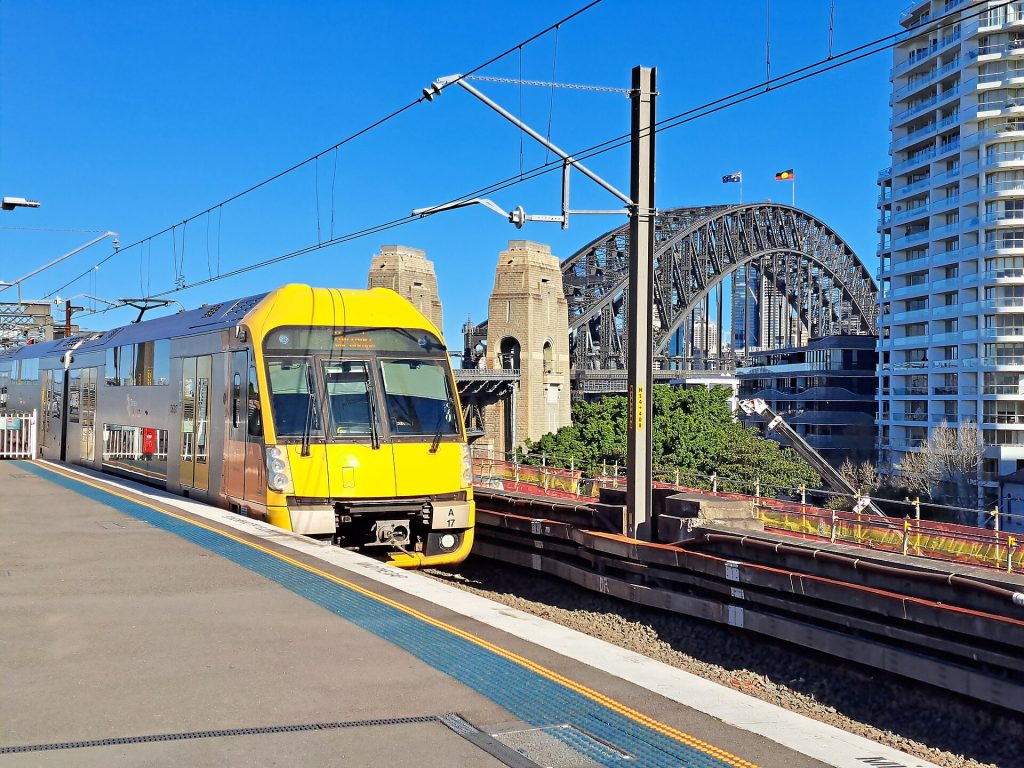
The book in my hands was Think by Svend Brinkmann — slim, dense, rich with ideas that required my focus. It was a book that asked me to slow down, and the train, as it turned out, was asking the same thing. Neither the journey nor the reading had any urgency. And nor did I. Instead, I did not rush through lines or scan ahead. I read slowly, looked up frequently, let my eyes rest on the passing city, then returned to the page. It did not feel like distraction. It felt like being.
Brinkmann, on those pages, was writing about the distinction Hannah Arendt draws in her (unfinished) book The Life of the Mind — drawing from Kant — between thinking and knowing. Knowledge, Arendt argues, is the accumulation of information that helps us function and survive. Thinking is something else entirely. It has no instrumental goal. It is done for its own sake, because the only thing it seeks is meaning. And through thinking, she writes, we can rise — even briefly — above the practical demands of living, and simply watch and reflect.
Brinkmann continues, explaining:
Arendt notes the etymological connection between the word theory (derived from theos), and the divine. To theorise and think philosophically is temporarily to adopt a divine view of the world. This is also supposedly the origin of the word theatre. When we are able to think and philosophise, we view the world as if we are gods in a theatre. This is true happiness. Achieving this requires a contemplative way of life that frees us from work, production and consumption – not as a permanent state of being, but from time to time. (Think, p. 78–79*)
I set the book down and looked out the window. The words were still settling in me, finding their places. And as the city moved past, I understood that the passage was not describing something aspirational. It was describing exactly what was happening. I had not engineered this. I had simply allowed it to happen.
There is a strange irony in the fact that Julia Cameron, whose Artist’s Way I had been reading in the weeks before, would have had something to say about my moment of self-awareness. Far from sharing my sense of serendipity at the meeting of word and experience, she may well have thought I had arrived there despite myself. Her objection would have been not to the phone I had put away, but to the book in my hands. Written in the 1990s, her message to commuters was to look up and let the mind wander freely, unmediated even by words. The call to look up is the same call in every era, only in a different guise. But what she was really warning against, I think, was the same thing I had spent much of my early life doing: using engagement as a shield against the discomfort of being alone with yourself.
I was a constant reader in my twenties — but not simply because of my love of reading alone. The quiet of my own mind was uncomfortable. If I was not in company, I was always in a book. Somewhere beneath all that engagement was an avoidance: of silence, of stillness, of whatever I might find if I sat alone with myself and had nothing to look at but my own life. I realise now that this young woman denied herself a great gift. To be alone with your own thoughts — really alone, without distraction as a buffer — is not a deprivation. It is, I have come to understand, one of the quiet privileges of being alive. The interior world, when you finally agree to inhabit it, turns out to be worth the visit.
On the train to St Ives, I was not afraid of the quiet. I moved between the book and the window. The reading and the looking were the same activity, in a way — both a form of attention, both a refusal of hurry. The journey permitted me to be slow, and slowness gave me access to something I do not often reach on an ordinary day.
Somewhere on that return journey, I wondered whether this experience could be reproduced deliberately. Whether I could simply decide, on an ordinary Tuesday, to take a long way somewhere. Not because it was necessary, but because the slowness itself was the point. A train. A book. A window. No hard deadline. No phone.
The shackles are real, of course. Life is a grind. There are responsibilities and appointments and the ordinary gravity of things that must be done. I do not want to pretend otherwise. But I have been asking myself, since that journey, how difficult it would be to loosen those bonds from time to time. To take the slow train. To sit in a park. To order a coffee and not open a screen. To let the mind rise, as Arendt says it can, above the instrumental, and simply watch and reflect. To be, even briefly, a god in a theatre.
* Svend Brinkmann, Think, Polity Press, 2024


Leave a Reply